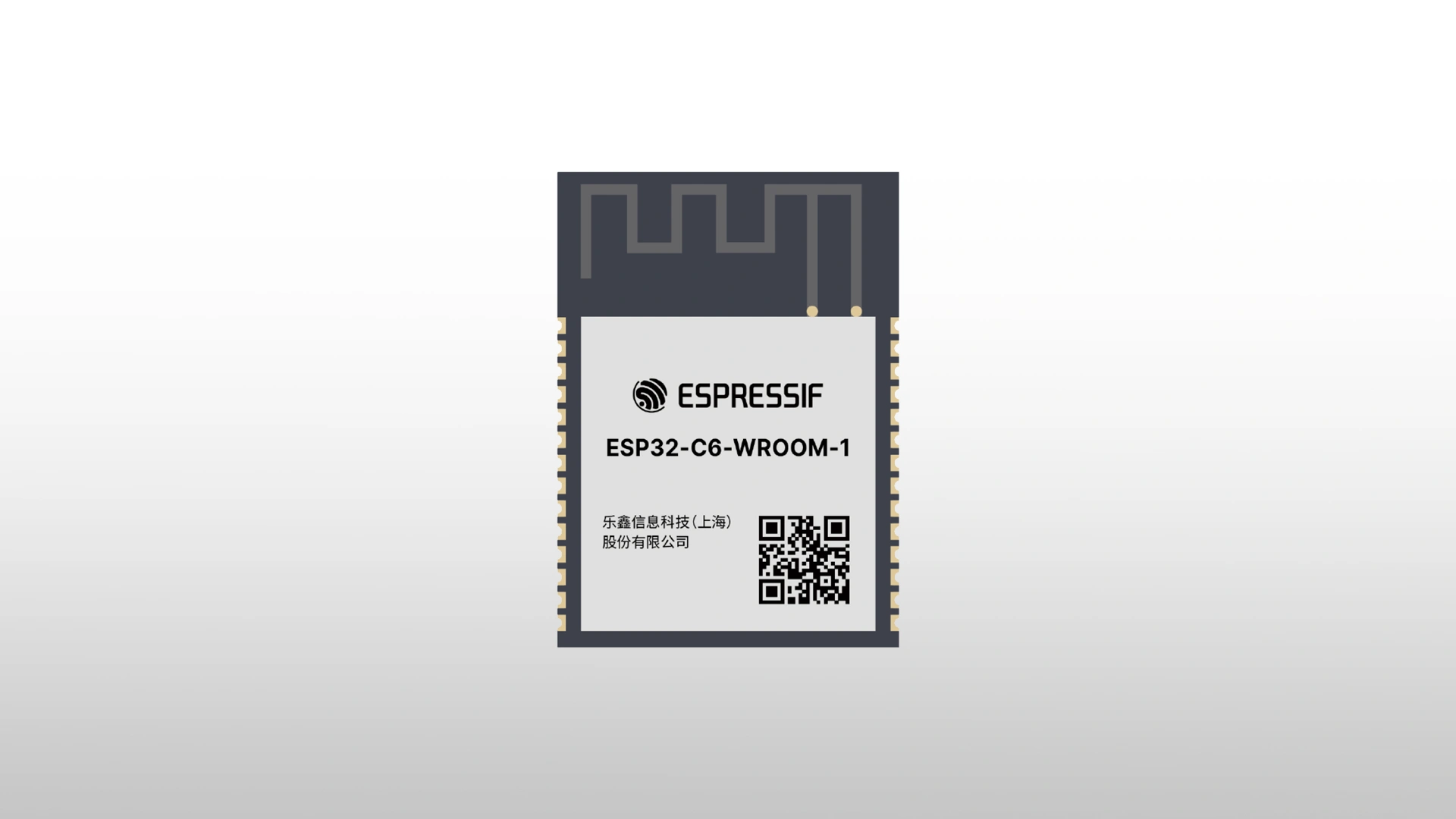
Component Header
| Manufacturer | Espressif Systems |
| Component Category | Wireless MCU Module |
| Component Type | 2.4 GHz Wi-Fi 6 + Bluetooth LE + 802.15.4 Module |
| Main Function | Wireless connectivity + embedded processing |
| Integrated SoC | ESP32-C6 |
| CPU | 32-bit RISC-V single-core |
| Maximum CPU Frequency | 160 MHz |
| Flash | 4 MB, 8 MB or 16 MB Quad SPI depending on variant |
| Antenna | Integrated PCB antenna |
| Module Size | 18.0 × 25.5 × 3.1 mm |
| Supply Voltage | 3.0–3.6 V |
| Operating Temperature | –40 to +85 °C |
| GPIO | 23 |
| Lifecycle | Current module family; verify exact MPN availability |
Quick Summary
The ESP32-C6-WROOM-1 is a compact wireless MCU module built around Espressif’s ESP32-C6. It combines a 160 MHz RISC-V single-core processor with 2.4 GHz Wi-Fi 6, Bluetooth 5 LE, 802.15.4 connectivity for Thread and Zigbee, flash memory and an integrated PCB antenna.
It is particularly useful for IoT products that need more than conventional Wi-Fi/Bluetooth, such as Matter/Thread devices, smart-home products, industrial IoT nodes and connected controllers.
What Is It?
The ESP32-C6-WROOM-1 integrates the ESP32-C6 SoC, SPI flash, a 40 MHz crystal oscillator, RF circuitry and a PCB antenna in an 18.0 × 25.5 × 3.1 mm module. The ESP32-C6 uses a 32-bit RISC-V single-core CPU running up to 160 MHz and supports 2.4 GHz Wi-Fi 6, Bluetooth 5 LE and IEEE 802.15.4. The 802.15.4 radio enables Thread and Zigbee applications. The module also provides 23 GPIOs and peripherals including UART, SPI, I²C, I²S, USB Serial/JTAG, TWAI, ADC, PWM and SDIO.
Key Specifications
| SoC | ESP32-C6 |
| CPU | 32-bit RISC-V single-core |
| Maximum CPU Frequency | 160 MHz |
| ROM | 320 KB |
| HP SRAM | 512 KB |
| LP SRAM | 16 KB |
| Flash | 4 MB / 8 MB / 16 MB Quad SPI, depending on variant |
| Wi-Fi | 2.4 GHz IEEE 802.11ax (Wi-Fi 6); also 802.11b/g/n |
| Wi-Fi Data Rate | Up to 150 Mbps |
| Bluetooth | Bluetooth 5.3 LE |
| 802.15.4 | IEEE 802.15.4-2015 |
| Thread | Thread 1.3 |
| Zigbee | Zigbee 3.0 |
| GPIO | 23 |
| ADC | 12-bit SAR ADC |
| UART | 3 |
| SPI | 2 |
| I²C | 1 |
| I²S | 1 |
| USB | USB Serial/JTAG |
| TWAI | 1 controller |
| Supply Voltage | 3.0–3.6 V |
| External Supply Capability | Minimum 0.5 A |
| Antenna | On-board PCB antenna |
| Module Dimensions | 18.0 × 25.5 × 3.1 mm |
| Operating Ambient Temperature | –40 to +85 °C |
Key Features
- 32-bit RISC-V single-core processor up to 160 MHz
- 2.4 GHz Wi-Fi 6 with IEEE 802.11ax support
- Bluetooth 5.3 LE
- IEEE 802.15.4 radio for Thread and Zigbee
- 4 MB, 8 MB or 16 MB flash variants
- 23 GPIOs and a broad peripheral set
- Integrated PCB antenna
- Low-power features including Target Wake Time support for Wi-Fi 6
Typical Applications
- Smart-home and Matter devices
- Thread and Zigbee products
- Industrial IoT controllers
- Wireless sensor nodes
- Smart appliances
- Connected lighting and building automation
- Energy-monitoring devices
- Consumer IoT products
Interfaces / Functions
| GPIO | Digital I/O and peripheral multiplexing |
| UART | Serial communication and debugging |
| SPI | External memories, displays and peripherals |
| I²C | Sensors and peripheral ICs |
| I²S | Digital audio |
| USB Serial/JTAG | Programming, debugging and serial communication |
| TWAI | CAN 2.0-compatible controller; external transceiver required |
| ADC | Analog signal measurement |
| LED PWM | LED and general PWM control |
| MCPWM | Motor and power-control applications |
| RMT | Timing-sensitive peripheral control |
| SDIO Slave | SDIO host/device applications |
| Wi-Fi 6 | IP/network connectivity |
| Bluetooth LE | Short-range wireless connectivity |
| 802.15.4 | Thread and Zigbee connectivity |
Power Requirements
The module operates from 3.0–3.6 V, with 3.3 V being the nominal supply voltage. Espressif specifies that the external power supply should be capable of delivering at least 0.5 A.
Power demand varies with radio mode, transmit power, CPU activity and peripheral use. For product designs, size the regulator and local decoupling for the actual wireless operating conditions rather than relying only on average MCU current.
Why Use This Component?
- Wi-Fi 6 support in a compact module
- Bluetooth LE plus Thread/Zigbee capability
- Single RISC-V MCU can handle application and wireless processing
- Integrated PCB antenna reduces RF design work
- Multiple wireless protocols enable Matter/IoT architectures
- 23 GPIOs and useful digital/analog peripherals
- Available with 4 MB, 8 MB and 16 MB flash options
- Low-power Wi-Fi features such as Target Wake Time
When Not to Use It
- 5 GHz Wi-Fi is required
- More processing performance than a 160 MHz single-core MCU is required
- An external antenna is mandatory; evaluate the ESP32-C6-WROOM-1U instead
- The application does not need Wi-Fi 6 or 802.15.4 and a simpler/cheaper MCU is sufficient
- The product requires a physical CAN transceiver integrated into the module
- A different wireless technology or frequency band is required
Key Selection Considerations
- Select the required flash variant: 4 MB, 8 MB or 16 MB
- Verify Wi-Fi 6, Bluetooth LE and 802.15.4 requirements
- Verify Thread/Zigbee software-stack requirements
- Check GPIO count and peripheral pin multiplexing
- Check 3.0–3.6 V supply compatibility
- Size the regulator for wireless peak-current demand
- Verify antenna placement and RF clearance
- Check operating temperature requirement
- Verify production availability of the exact MPN
- Check required regional RF certifications for the finished product
Design Considerations
Power Supply
Use a stable 3.3 V rail with adequate transient-current capability. Espressif specifies a minimum 0.5 A external supply capability.
Decoupling
Place supply bypass capacitors close to the module and follow Espressif’s reference schematic and hardware-design recommendations.
Boot and Strapping
Several GPIOs have boot or strapping functions. External circuitry should not unintentionally force an undesired boot configuration during reset.
Wireless Coexistence
The module integrates Wi-Fi, Bluetooth LE and 802.15.4 radios sharing the RF subsystem. Application requirements involving simultaneous wireless protocols should be checked against the ESP32-C6 software and coexistence capabilities.
TWAI / CAN
The ESP32-C6 includes a TWAI controller, but the module does not provide the physical CAN transceiver. An external CAN transceiver is required for a physical CAN bus.
PCB / Layout Considerations
- Follow Espressif’s recommended PCB land pattern.
- Keep the integrated PCB antenna area clear according to the datasheet.
- Minimize nearby metal and copper that can detune or obstruct the antenna.
- Keep noisy and high-current routing away from the antenna region.
- Provide a suitable ground plane and controlled power distribution.
- Place supply decoupling close to the module power pins.
- Consider the final enclosure and nearby mechanical metal when positioning the antenna.
- Follow Espressif’s layout recommendations for USB, high-speed signals and the selected module configuration.
Equivalent ICs / Alternatives
ESP32-C6-WROOM-1-N4
| Manufacturer | Espressif Systems |
| Description | 4 MB flash ESP32-C6-WROOM-1 module |
| Major Difference | 4 MB Quad SPI flash |
| Compatibility | Same module family |
ESP32-C6-WROOM-1-N8
| Manufacturer | Espressif Systems |
| Description | 8 MB flash ESP32-C6-WROOM-1 module |
| Major Difference | 8 MB Quad SPI flash |
| Compatibility | Same module family |
ESP32-C6-WROOM-1-N16
| Manufacturer | Espressif Systems |
| Description | 16 MB flash ESP32-C6-WROOM-1 module |
| Major Difference | 16 MB Quad SPI flash |
| Compatibility | Same module family |
ESP32-C6-WROOM-1U
| Manufacturer | Espressif Systems |
| Description | ESP32-C6 module with external antenna connector |
| Major Difference | External antenna instead of integrated PCB antenna |
| Compatibility | Alternative with Design Changes |
ESP32-C6-MINI-1
| Manufacturer | Espressif Systems |
| Description | Smaller ESP32-C6 module family |
| Major Difference | Smaller module format and different mechanical footprint |
| Compatibility | Alternative with Design Changes |
Where to Buy
The ESP32-C6-WROOM-1 family is available in multiple flash configurations. The exact MPN should be specified when purchasing.
- DigiKey
- Mouser
- Adafruit
- Robu India
- LCSC
- Other authorized regional distributors
Stock, pricing and regional availability are dynamic and should be verified at the time of procurement.
Manufacturer & Datasheet
Manufacturer: Espressif Systems
Official product page: https://www.espressif.com/en/module/esp32-c6-wroom-1-en
Official datasheet: ESP32-C6-WROOM-1 & ESP32-C6-WROOM-1U Datasheet, Version 1.4, December 10, 2025.
Related documentation: ESP32-C6 Series Datasheet, ESP32-C6 Hardware Design Guidelines, ESP32-C6 Technical Reference Manual and ESP-IDF Programming Guide.
FAQ
What is ESP32-C6-WROOM-1?
It is an ESP32-C6-based wireless MCU module combining a 160 MHz RISC-V processor, Wi-Fi 6, Bluetooth LE and IEEE 802.15.4 connectivity.
Does ESP32-C6-WROOM-1 support Wi-Fi 6?
Yes. It supports 2.4 GHz IEEE 802.11ax Wi-Fi 6 and is also compatible with 802.11b/g/n.
Does ESP32-C6 support Thread and Zigbee?
Yes. Its IEEE 802.15.4 radio supports Thread 1.3 and Zigbee 3.0.
How much flash is available?
The ESP32-C6-WROOM-1 family is available with 4 MB, 8 MB and 16 MB Quad SPI flash variants.
Does it have Bluetooth?
Yes. It supports Bluetooth 5.3 Low Energy.
Does it have a built-in antenna?
Yes. The WROOM-1 uses an integrated PCB antenna. The WROOM-1U version provides an external antenna connector.
Can it connect directly to a CAN bus?
No. The ESP32-C6 has a TWAI controller, but an external CAN transceiver is required for physical CAN-bus connectivity.
ICDigest Engineering Takeaway
The ESP32-C6-WROOM-1 is aimed at modern connected products that need more than conventional Wi-Fi and Bluetooth. Its combination of Wi-Fi 6, Bluetooth 5.3 LE and IEEE 802.15.4 makes it particularly relevant for Thread, Zigbee and Matter-oriented IoT designs.
The key selection points are the exact flash variant, 802.15.4 software requirements, wireless power demand, antenna placement, GPIO/peripheral allocation and the 3.0–3.6 V supply. For a design requiring an external antenna, evaluate the ESP32-C6-WROOM-1U rather than treating it as a footprint-equivalent replacement.