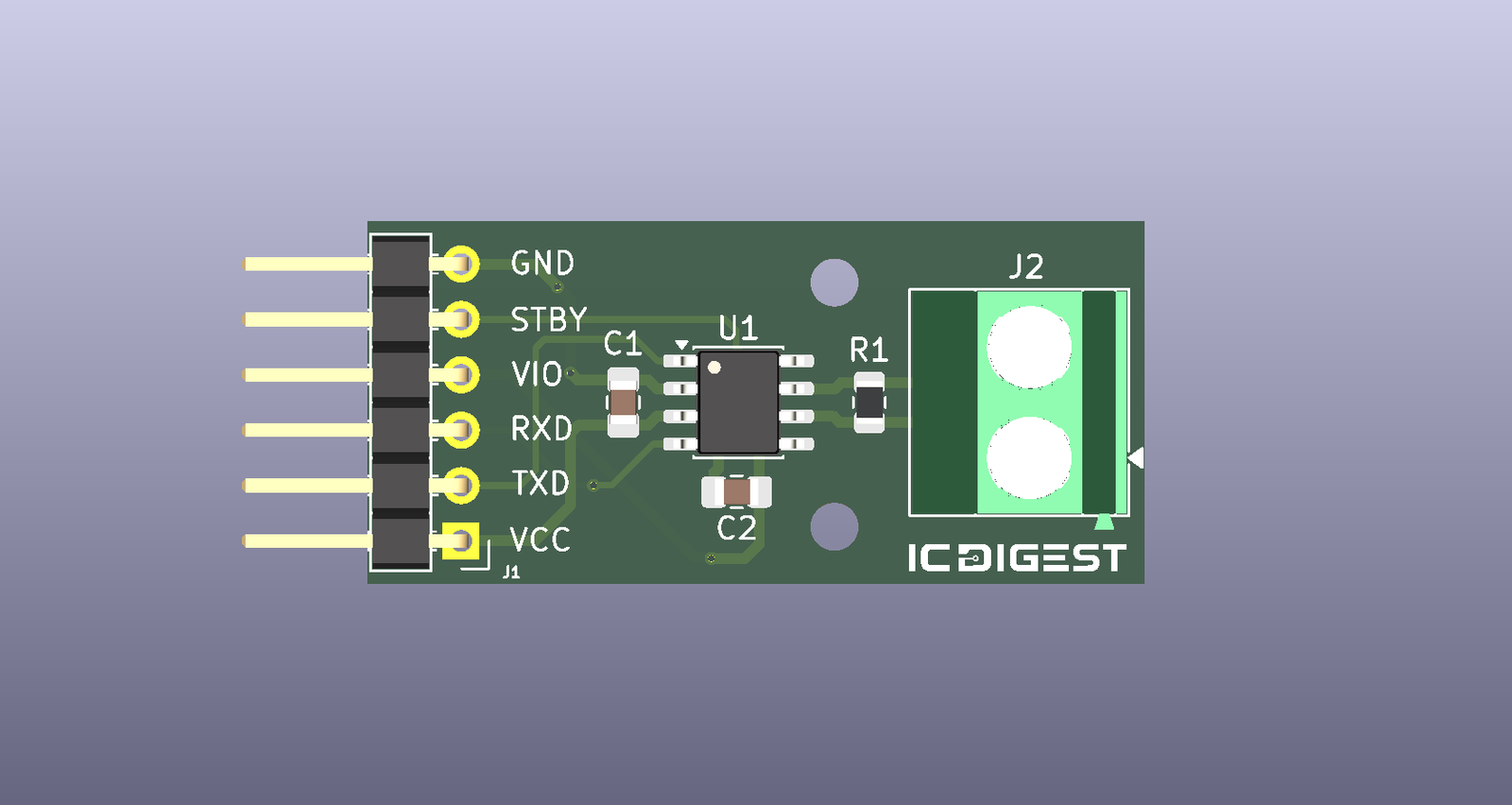
Information Header
| Field | Value |
| Design Block ID | DB-0002 |
| Design Block Name | CAN FD Interface using MCP2562FD |
| Category | Communication |
| Sub Category | CAN FD Bus |
| Primary IC | MCP2562FD |
| Manufacturer | Microchip Technology |
| Protocol | CAN FD / CAN 2.0 |
| Difficulty | Intermediate |
| Version | 1.0 |
| License | CERN-OHL-S v2 |
Quick Summary
The CAN FD Interface using MCP2562FD Design Block provides a production-ready physical layer interface for CAN FD (Flexible Data-Rate) communication using the Microchip MCP2562FD high-speed CAN FD transceiver. It supports both Classical CAN and CAN FD networks, enabling higher data rates, improved bandwidth, and backward compatibility. This Design Block is intended for commercial and industrial embedded systems requiring robust, high-speed CAN communication.
Overview
The MCP2562FD is a high-speed CAN FD transceiver compliant with ISO 11898-2:2016. It interfaces a CAN controller with the physical CAN bus by converting single-ended logic signals into differential CANH and CANL signals.
Unlike the MCP2562, the MCP2562FD supports the higher switching speeds required by CAN FD while maintaining compatibility with Classical CAN. It also includes the VIO pin for direct interfacing with logic voltages ranging from 1.8 V to 5.5 V, making it suitable for modern microcontrollers and processors.
This Design Block provides a reusable hardware interface suitable for CAN FD networks used in automotive, industrial automation, robotics, and high-performance embedded systems.
Applications
- Automotive Electronic Control Units (ECUs)
- Electric Vehicle (EV) Controllers
- Battery Management Systems (BMS)
- Motor Controllers
- Industrial PLCs
- Robotics
- Factory Automation
- Industrial Gateways
- Data Acquisition Systems
- Smart Energy Systems
- Autonomous Mobile Robots (AMRs)
- Agricultural Equipment
- Construction Equipment
- Medical Equipment
- Embedded Control Systems
Hardware Specifications
| Parameter | Specification |
| Primary IC | MCP2562FD |
| Communication Standard | ISO 11898-2:2016 |
| Protocol Support | CAN FD / Classical CAN |
| Maximum Classical CAN Data Rate | 1 Mbps |
| Maximum CAN FD Data Rate | Up to 8 Mbps |
| Supply Voltage (VDD) | 4.5 V to 5.5 V |
| Logic Supply (VIO) | 1.8 V to 5.5 V |
| Bus Interface | Differential (CANH/CANL) |
| Standby Mode | Supported |
| Thermal Protection | Internal |
| Isolation | No |
Complete BOM
| Ref | Component | Recommended Part | Value / Rating | Package | Manufacturer |
| U1 | CAN FD Transceiver | MCP2562FD-E/SN | — | SOIC-8 | Microchip |
| C1 | Decoupling Capacitor | GRM188R71H104KA93 | 100 nF, X7R, 50 V | 0603 | Murata |
| C2 | Bulk Capacitor | GRM188R60J105KA01 | 1 µF, X5R | 0603 | Murata |
| FB1 | Ferrite Bead | BLM18AG601SN1D | 600 Ω @100 MHz | 0603 | Murata |
| D1 | CAN TVS Diode | SM24CANB | CAN Bus TVS | SMB | Littelfuse |
| L1 | Common Mode Choke | ACT45B-510-2P | CAN Choke | SMD | TDK |
| R1 | Termination Resistor | CRCW0603120RFKEA | 120 Ω, 1%, 0.1 W | 0603 | Vishay |
| JP1 | Termination Jumper | Solder Jumper | — | PCB | — |
| J1 | CAN Connector | 3-Pin Terminal Block | 3.5 mm Pitch | TH | Phoenix Contact |
Equivalent ICs
| IC | Manufacturer | Notes |
| MCP2561FD | Microchip Technology | Fully compatible for most applications using the same reference design |
Approved Alternatives
| Component | Primary Part | Approved Alternative |
| TVS Diode | SM24CANB | PESD1CAN |
| Common Mode Choke | ACT45B-510-2P | WE-CNSW Series |
| Ferrite Bead | BLM18AG601SN1D | MPZ1608 Series |
| 100 nF Capacitor | Murata GRM Series | Samsung CL10 Series |
| 1 µF Capacitor | Murata GRM Series | TDK C1608 Series |
| Terminal Block | Phoenix Contact | Degson DG301 Series |
FAQ
1. What is the difference between CAN and CAN FD?
CAN FD (Flexible Data-Rate) supports larger payloads and significantly higher data rates than Classical CAN while maintaining backward compatibility.
2. Can the MCP2562FD communicate on a Classical CAN network?
Yes. It supports both Classical CAN and CAN FD networks.
3. Does this Design Block include a CAN FD controller?
No. The MCP2562FD is only the physical layer transceiver. A CAN FD controller, typically integrated into the microcontroller, is required.
4. Can this Design Block be used with 3.3 V microcontrollers?
Yes. The VIO pin supports logic voltages from 1.8 V to 5.5 V.
5. Is the 120 Ω termination resistor always required?
No. It should only be installed on nodes located at each end of the CAN bus.