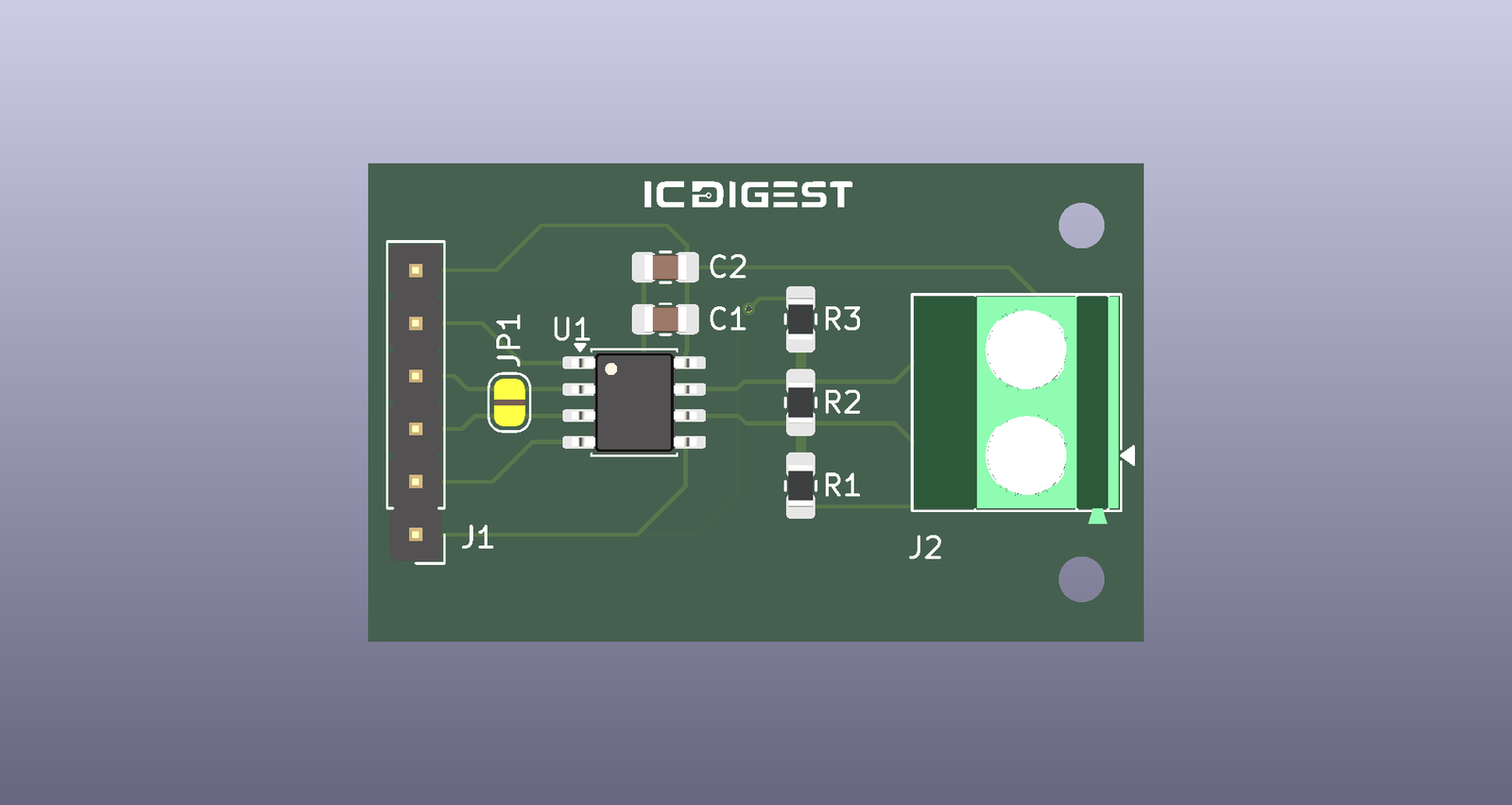
Information Header
| Field | Value |
| Design Block ID | DB-0004 |
| Design Block Name | RS485 Interface using MAX3485 |
| Category | Communication |
| Sub Category | RS485 Interface |
| Primary IC | MAX3485 |
| Manufacturer | Maxim Integrated (Analog Devices) |
| Protocol | TIA/EIA-485-A (RS485) |
| Difficulty | Intermediate |
| Version | 1.0 |
| License | CERN-OHL-S v2 |
Quick Summary
The RS485 Interface using MAX3485 Design Block provides a production-ready half-duplex RS485 communication interface for embedded systems. It enables reliable long-distance differential serial communication with excellent noise immunity and supports multi-drop network configurations. This Design Block is suitable for industrial automation, Modbus RTU, building automation, energy metering, HVAC systems, and other applications requiring robust serial communication.
Overview
The MAX3485 is a low-power, half-duplex RS485/RS422 transceiver designed for 3.3 V systems. It converts standard UART transmit (TX) and receive (RX) logic signals into differential RS485 bus signals (A and B), providing reliable communication over long cable lengths in electrically noisy environments.
The transceiver supports up to 32 nodes on a single RS485 bus and includes driver enable (DE) and receiver enable (RE̅) control pins for half-duplex communication. The differential signaling improves noise immunity, making the MAX3485 suitable for industrial and commercial communication networks.
Applications
- Modbus RTU Networks
- Industrial PLCs
- Building Automation
- Smart Energy Meters
- HVAC Controllers
- Factory Automation
- Data Acquisition Systems
- Industrial Gateways
- Remote I/O Modules
- Motor Controllers
- Elevator Control Systems
- Agricultural Automation
- Security and Access Control Systems
- Embedded Serial Communication
- Environmental Monitoring Systems
Hardware Specifications
| Parameter | Specification |
| Primary IC | MAX3485 |
| Communication Standard | TIA/EIA-485-A |
| Communication Mode | Half-Duplex |
| Supply Voltage | 3.0 V to 3.6 V |
| Logic Interface | UART (TXD/RXD) |
| Maximum Data Rate | 10 Mbps |
| Maximum Bus Length | Up to 1200 m (application dependent) |
| Number of Nodes | Up to 32 Unit Loads |
| Bus Interface | Differential (A/B) |
| Operating Temperature | Device variant dependent |
| Isolation | No |
Complete BOM
| Ref | Component | Recommended Part | Value / Rating | Package | Manufacturer |
| U1 | RS485 Transceiver | MAX3485ESA+T | — | SOIC-8 | Analog Devices |
| C1 | Decoupling Capacitor | GRM188R71H104KA93 | 100 nF, X7R, 50 V | 0603 | Murata |
| C2 | Bulk Capacitor | GRM188R60J105KA01 | 1 µF, X5R | 0603 | Murata |
| FB1 | Ferrite Bead | BLM18AG601SN1D | 600 Ω @100 MHz | 0603 | Murata |
| D1 | RS485 TVS Diode | SM712 | RS485 Protection | SOIC | Littelfuse |
| R1 | Termination Resistor | CRCW0603120RFKEA | 120 Ω, 1% | 0603 | Vishay |
| R2 | Pull-Up Resistor | CRCW06034K70FKEA | 4.7 kΩ | 0603 | Vishay |
| R3 | Pull-Down Resistor | CRCW06034K70FKEA | 4.7 kΩ | 0603 | Vishay |
| JP1 | Termination Jumper | Solder Jumper | — | PCB | — |
| J1 | RS485 Connector | 3-Pin Terminal Block | 3.5 mm Pitch | TH | Phoenix Contact |
Equivalent ICs
| IC | Manufacturer | Notes |
| MAX3483 | Analog Devices | Same application circuit for most half-duplex 3.3 V RS485 designs |
| MAX3486 | Analog Devices | Same reference design with different slew-rate characteristics |
Approved Alternatives
| Component | Primary Part | Approved Alternative |
| RS485 Transceiver | MAX3485 | SN65HVD75 (schematic verification required) |
| TVS Diode | SM712 | PESD2CAN |
| Ferrite Bead | BLM18AG601SN1D | MPZ1608 Series |
| 100 nF Capacitor | Murata GRM Series | Samsung CL10 Series |
| 1 µF Capacitor | Murata GRM Series | TDK C1608 Series |
| Terminal Block | Phoenix Contact | Degson DG301 Series |
FAQ
1. What is the difference between RS232 and RS485?
RS485 uses differential signaling, allowing longer communication distances, higher noise immunity, and multi-drop networking compared to RS232.
2. Does the MAX3485 support full-duplex communication?
No. The MAX3485 is a half-duplex transceiver. For full-duplex communication, use a dedicated full-duplex RS485 transceiver.
3. Is the 120 Ω termination resistor always required?
No. It should only be installed on devices located at each end of the RS485 bus.
4. Why are pull-up and pull-down resistors used?
They create a fail-safe bias network that ensures a known bus state when no device is actively driving the communication line.
5. Can the MAX3485 communicate with a 5 V microcontroller?
The MAX3485 is designed for 3.3 V logic. For direct 5 V systems, select a compatible 5 V RS485 transceiver or provide appropriate level translation if required.