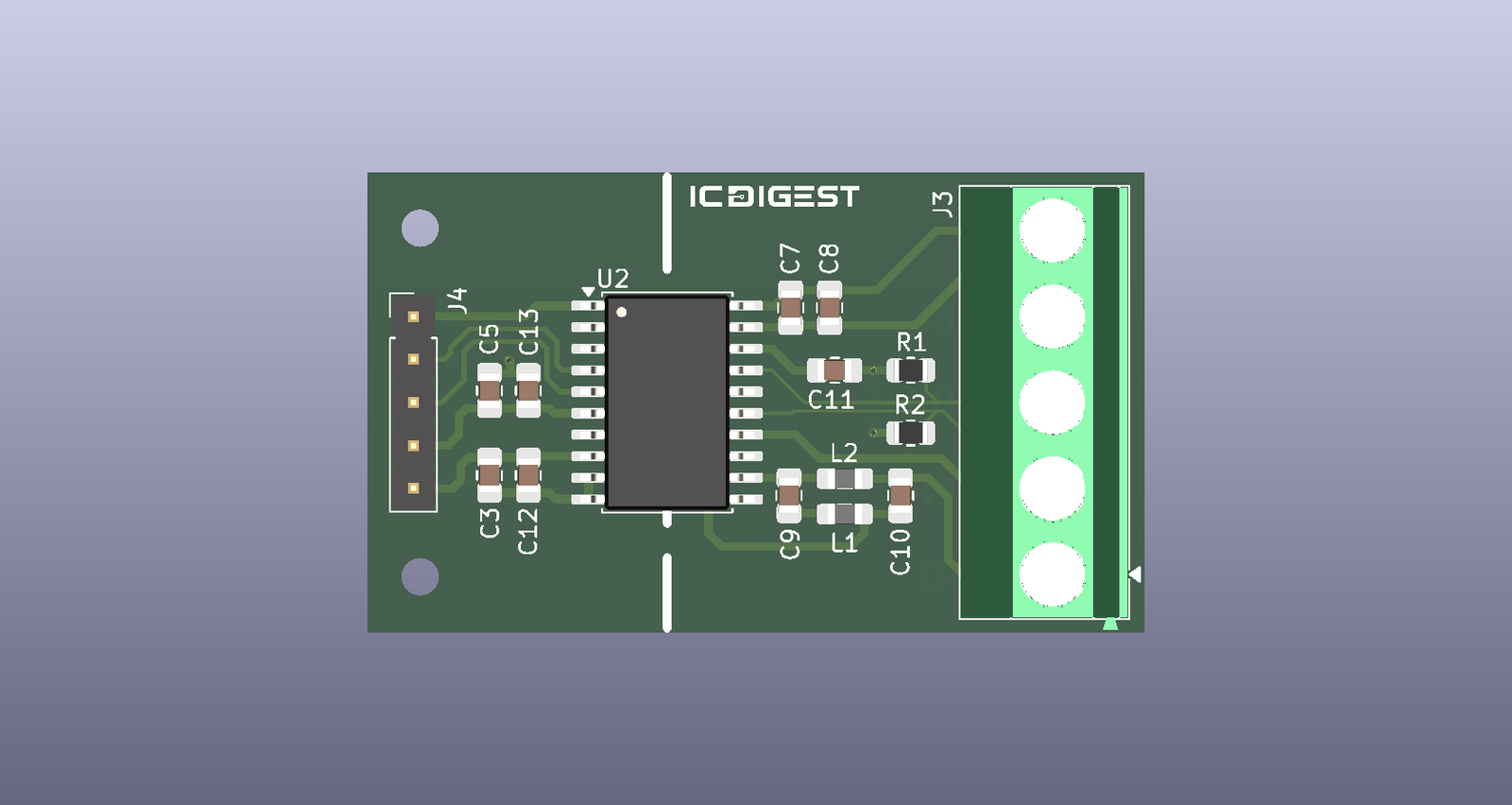
Information Header
| Field | Value |
| Design Block ID | DB-0003 |
| Design Block Name | Isolated CAN Bus Interface using ADM3053 |
| Category | Communication |
| Sub Category | Isolated CAN Bus |
| Primary IC | ADM3053 |
| Manufacturer | Analog Devices |
| Protocol | CAN 2.0A / CAN 2.0B |
| Difficulty | Advanced |
| Version | 1.0 |
| License | CERN-OHL-S v2 |
Quick Summary
The Isolated CAN Bus Interface using ADM3053 Design Block provides a fully isolated CAN communication interface by integrating galvanic isolation, a high-speed CAN transceiver, and an isolated DC-DC converter into a single IC. This Design Block is intended for industrial automation, motor drives, battery management systems (BMS), renewable energy systems, and other applications where electrical isolation is required to protect equipment and improve system reliability.
Overview
The ADM3053 is an isolated CAN transceiver that combines three essential functions into a single device:
- High-speed CAN transceiver
- Digital signal isolation
- Integrated isolated DC-DC power supply
By integrating these functions, the ADM3053 significantly reduces PCB area, component count, and design complexity compared to traditional isolated CAN implementations using separate digital isolators, transceivers, and isolated power supplies.
This Design Block provides a production-ready isolated CAN interface suitable for systems operating in electrically noisy or high-voltage environments where galvanic isolation is essential.
Applications
- Industrial PLCs
- Factory Automation
- Motor Drives
- Servo Controllers
- Battery Management Systems (BMS)
- Electric Vehicle Chargers
- Solar Inverters
- Energy Storage Systems (ESS)
- Smart Grid Equipment
- Industrial Gateways
- Robotics
- Process Control Systems
- Medical Equipment
- Railway Electronics
- High-Voltage Embedded Systems
Hardware Specifications
| Parameter | Specification |
| Primary IC | ADM3053 |
| Communication Standard | ISO 11898-2 |
| CAN Version | CAN 2.0A / CAN 2.0B |
| Maximum Data Rate | 1 Mbps |
| Isolation Type | Galvanic Isolation |
| Integrated Isolated DC-DC Converter | Yes |
| Logic Supply Voltage | 3.0 V to 5.5 V |
| Bus Supply | Generated Internally |
| Isolation Voltage | 2.5 kVrms (device dependent) |
| Operating Temperature | Device variant dependent |
| Isolation Barrier | Integrated |
| Standby Mode | Supported |
Complete BOM
| Ref | Component | Recommended Part | Value / Rating | Package | Manufacturer |
| U1 | Isolated CAN Transceiver | ADM3053BRWZ | — | SOIC-20 Wide Body | Analog Devices |
| C1 | Decoupling Capacitor | GRM188R71H104KA93 | 100 nF, X7R | 0603 | Murata |
| C2 | Bulk Capacitor | GRM188R60J105KA01 | 1 µF, X5R | 0603 | Murata |
| C3 | Isolated Supply Capacitor | GRM188R61H475KE11 | 4.7 µF | 0603 | Murata |
| D1 | CAN TVS Diode | SM24CANB | CAN Protection | SMB | Littelfuse |
| L1 | Common Mode Choke | ACT45B-510-2P | CAN Choke | SMD | TDK |
| R1 | Termination Resistor | CRCW0603120RFKEA | 120 Ω, 1% | 0603 | Vishay |
| JP1 | Termination Jumper | Solder Jumper | — | PCB | — |
| J1 | CAN Connector | 3-Pin Terminal Block | 3.5 mm | TH | Phoenix Contact |
Equivalent ICs
No fully compatible isolated CAN transceiver is available that can generally use the same schematic without modification.
Approved Alternatives
| Component | Primary Part | Approved Alternative |
| TVS Diode | SM24CANB | PESD1CAN |
| Common Mode Choke | ACT45B-510-2P | WE-CNSW Series |
| Ferrite Bead (if used) | BLM18AG601SN1D | MPZ1608 Series |
| 100 nF Capacitor | Murata GRM Series | Samsung CL10 Series |
| 1 µF Capacitor | Murata GRM Series | TDK C1608 Series |
| 4.7 µF Capacitor | Murata GRM Series | TDK C1608 Series |
| Terminal Block | Phoenix Contact | Degson DG301 Series |
FAQ
1. Why use an isolated CAN interface instead of a standard CAN transceiver?
Galvanic isolation protects low-voltage control electronics from high-voltage faults, eliminates ground loops, and improves system reliability in electrically noisy environments.
2. Does the ADM3053 require an external isolated power supply?
No. The ADM3053 includes an integrated isolated DC-DC converter, reducing external component count.
3. Is a CAN controller included in the ADM3053?
No. The ADM3053 is an isolated CAN transceiver. A CAN controller, typically integrated into the microcontroller, is still required.
4. Can this Design Block be used in automotive applications?
While technically possible, the ADM3053 is primarily intended for industrial applications. Automotive designs should use components that meet the required automotive qualification standards.
5. Is the 120 Ω termination resistor always required?
No. It should only be installed if the node is located at one end of the CAN bus.