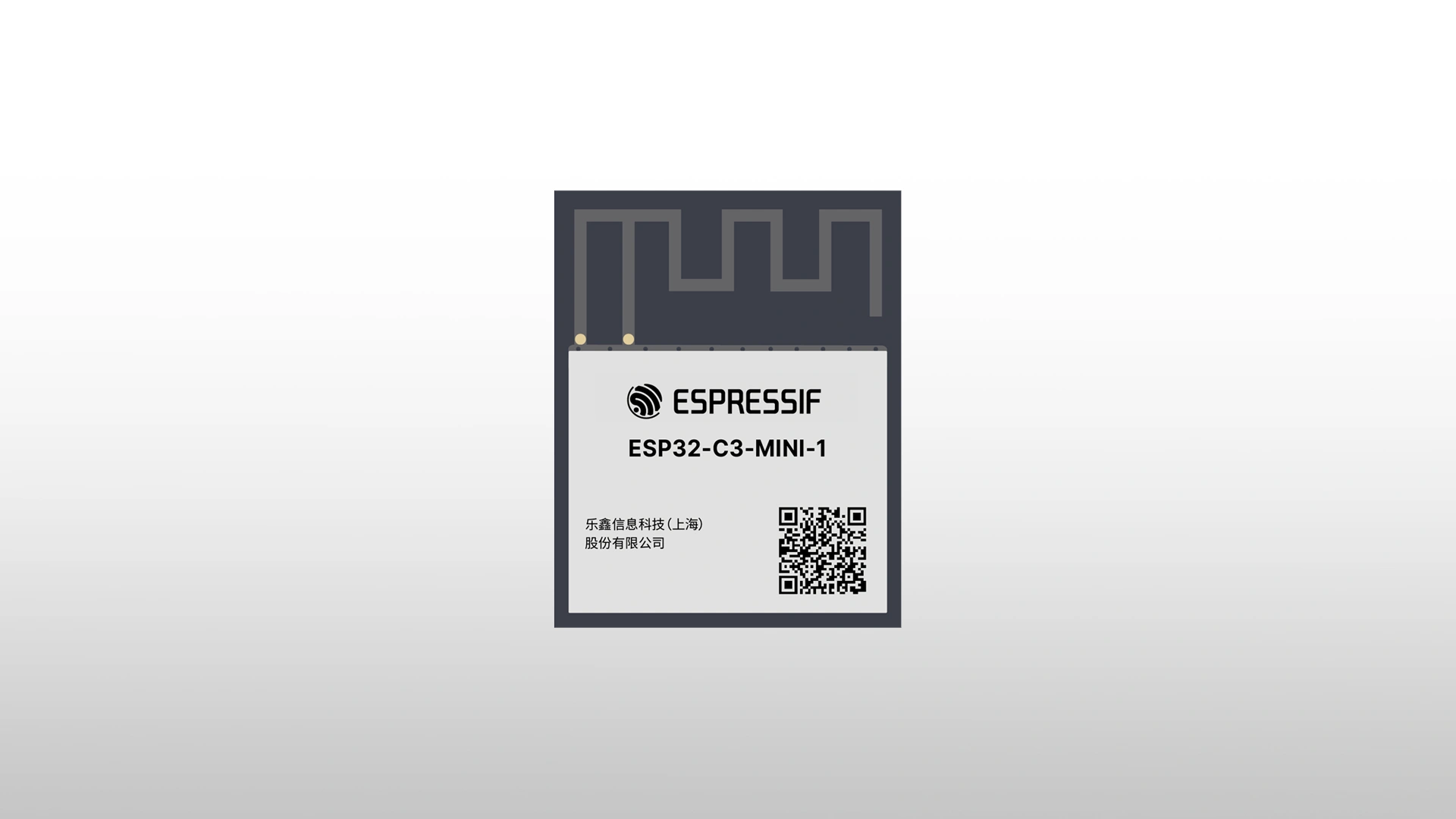
| Manufacturer | Espressif Systems |
| Component Category: | Wireless MCU Module |
| Component Type: | 2.4 GHz Wi-Fi + Bluetooth LE Module |
| Main Function: | Wireless connectivity + embedded processing |
| Integrated SoC: | ESP32-C3FH4X |
| Flash: | 4 MB Quad SPI |
| Antenna: | Integrated PCB antenna |
| Module Size: | 13.2 × 16.6 × 2.4 mm |
| Operating Temperature: | –40 to +85 °C |
| Lifecycle: | Active Recommended |
1. Quick Summary
The ESP32-C3-MINI-1-N4X is a compact wireless MCU module based on Espressif’s ESP32-C3FH4X SoC. It combines a 32-bit RISC-V single-core processor, 4 MB flash, 2.4 GHz Wi-Fi, Bluetooth 5 LE and multiple peripheral interfaces in a small module with an integrated PCB antenna.
It is suited to connected embedded products such as smart-home devices, industrial IoT equipment, wireless sensors, data loggers and consumer electronics. Espressif currently lists the N4X variant as Recommended.
2. What Is It?
The ESP32-C3-MINI-1-N4X is a ready-to-integrate wireless MCU module containing the ESP32-C3FH4X SoC, 4 MB Quad SPI flash, a 40 MHz crystal, RF matching circuitry and an onboard PCB antenna.
The integrated ESP32-C3 provides a 32-bit RISC-V single-core processor running up to 160 MHz, 2.4 GHz 802.11 b/g/n Wi-Fi and Bluetooth 5 LE. The module exposes up to 15 GPIOs and supports interfaces including UART, SPI, I²C, I²S, USB Serial/JTAG and TWAI, along with an SAR ADC and other peripherals.
The main engineering advantage is that the wireless subsystem and antenna are integrated into a compact module, reducing the amount of RF hardware that needs to be designed directly on the host PCB.
3. Key Specifications
| Parameter | ESP32-C3-MINI-1-N4X |
| Integrated SoC | ESP32-C3FH4X |
| CPU | 32-bit RISC-V single-core |
| Maximum CPU frequency | 160 MHz |
| ROM | 384 KB |
| SRAM | 400 KB |
| RTC SRAM | 8 KB |
| Flash | 4 MB Quad SPI |
| Wi-Fi | IEEE 802.11 b/g/n |
| Wi-Fi frequency | 2.4 GHz |
| Wi-Fi bandwidth | 20 / 40 MHz |
| Maximum Wi-Fi data rate | 150 Mbps |
| Bluetooth | Bluetooth 5 LE |
| Bluetooth LE data rates | 125 Kbps, 500 Kbps, 1 Mbps, 2 Mbps |
| GPIO | Up to 15 |
| ADC | SAR ADC |
| UART | Supported |
| SPI | Supported |
| I²C | Supported |
| I²S | Supported |
| USB | USB Serial/JTAG |
| CAN controller | TWAI, CAN 2.0 compatible |
| Supply voltage | 3.0–3.6 V |
| Nominal supply | 3.3 V |
| Recommended external supply capability | Minimum 0.5 A |
| PCB antenna | Integrated |
| Module dimensions | 13.2 × 16.6 × 2.4 mm |
| Ambient temperature | –40 to +85 °C |
| Chip revision | v1.1 |
Espressif specifies 4 MB Quad SPI flash, 15 GPIOs, a 160 MHz RISC-V processor and the listed wireless/peripheral capabilities for the module family.
4. Key Features
- 32-bit RISC-V single-core processor up to 160 MHz
- 4 MB Quad SPI flash integrated in the SoC package
- 2.4 GHz IEEE 802.11 b/g/n Wi-Fi
- Bluetooth 5 LE and Bluetooth Mesh support
- Integrated PCB antenna
- Up to 15 GPIOs
- USB Serial/JTAG controller
- TWAI controller compatible with ISO 11898-1 / CAN 2.0
- Low-power operating modes
- Hardware security features provided by the ESP32-C3 platform
The module also integrates a 40 MHz crystal oscillator and RF matching circuitry, reducing external RF components required on the host design.
5. Typical Applications
- Smart-home products
- Industrial IoT controllers
- Wireless sensor nodes
- Smart appliances
- Energy-monitoring equipment
- IoT data loggers
- Smart agriculture equipment
- Point-of-sale equipment
- Consumer electronics
- Low-power connected devices
These application areas are consistent with Espressif’s listed applications for the ESP32-C3-MINI-1 family.
6. Interfaces / Functions
| Interface / Function | Practical Use |
| GPIO | Digital inputs, outputs and peripheral signals |
| UART | Debugging and external serial devices |
| SPI | Displays, sensors and high-speed peripherals |
| I²C | Sensors and peripheral ICs |
| I²S | Digital audio |
| USB Serial/JTAG | Programming, debugging and serial communication |
| TWAI | CAN 2.0-compatible controller |
| SAR ADC | Analog signal measurement |
| LED PWM | LED and actuator control |
| RMT | Timing-based control and communication |
| Wi-Fi | Network and Internet connectivity |
| Bluetooth LE | Short-range wireless communication |
Important
TWAI is a CAN controller, not a CAN transceiver.
A separate CAN physical-layer transceiver is required when connecting the module to a physical CAN bus.
7. Power Requirements
The module operates from a 3.0–3.6 V supply, with 3.3 V being the nominal operating voltage. Espressif specifies that the external power supply should be capable of delivering at least 0.5 A.
Wireless transmission causes substantially higher current demand than normal MCU operation.
| Operating condition | Typical/Peak current |
| Wi-Fi TX, 802.11b @ 20.5 dBm | 350 mA peak |
| Wi-Fi TX, 802.11g @ 18 dBm | 295 mA peak |
| Wi-Fi TX, 802.11n HT20 @ 17.5 dBm | 290 mA peak |
| Wi-Fi RX, HT20 | 82 mA peak |
| Wi-Fi RX, HT40 | 84 mA peak |
| Bluetooth LE TX @ 20 dBm | 340 mA peak |
| Bluetooth LE RX | 86 mA peak |
| Light-sleep | 130 µA typical |
| Deep-sleep | 5 µA typical |
These are Espressif’s specified/test-condition values and should not be interpreted as a single constant operating current.
Design implication
The 3.3 V regulator should be selected for wireless peak current, not merely the average MCU current. Local decoupling and adequate power-rail integrity are also important.
8. Why Use This Component?
An engineer may select the ESP32-C3-MINI-1-N4X when the design needs:
- Integrated Wi-Fi and Bluetooth LE
- A compact wireless MCU
- RISC-V processing
- 4 MB flash
- Integrated PCB antenna
- Multiple digital interfaces
- USB Serial/JTAG
- CAN-controller functionality through TWAI
- Low-power operating modes
- A small module footprint
- A currently recommended ESP32-C3-MINI-1 variant
The N4X is particularly relevant when designing a new product because Espressif lists it as Recommended, while the older N4 is listed as NRND.
9. When Not to Use It
Consider another device or module when:
- 5 GHz Wi-Fi is required.
- Wi-Fi 6 is required.
- Thread or Zigbee/802.15.4 connectivity is required.
- More than 4 MB flash is required and the available N4X configuration is insufficient.
- A large number of GPIOs or peripherals is required.
- An external antenna is mandatory.
- The product requires an integrated CAN transceiver.
- A temperature range beyond –40 to +85 °C is required.
- The application needs significantly higher processing performance.
- The module’s PCB antenna cannot be positioned according to Espressif’s RF layout requirements.
For a higher-temperature ESP32-C3-MINI-1 design, the ESP32-C3-MINI-1-H4X is the corresponding 105 °C variant with the newer v1.1 chip revision.
10. Key Selection Considerations
Before selecting ESP32-C3-MINI-1-N4X, verify:
- Required Wi-Fi functionality
- Required Bluetooth LE functionality
- 4 MB flash capacity
- GPIO count and pin multiplexing
- Required UART/SPI/I²C/I²S interfaces
- ADC requirements
- TWAI/CAN-controller requirement
- 3.0–3.6 V power rail
- Power supply peak-current capability
- Antenna placement
- PCB RF keep-out requirements
- –40 to +85 °C temperature range
- Production availability
- Required regulatory/certification conditions
- Firmware/ESP-IDF version compatibility
11. Design Considerations
Power Supply
Provide a stable 3.3 V supply capable of handling the module’s wireless current peaks. Espressif specifies a minimum 0.5 A external supply capability.
Decoupling
Place the required supply bypass/decoupling components close to the module’s supply connection and follow Espressif’s reference schematic.
EN / Reset
The EN pin controls chip enable/reset behavior. The reset and power-up circuit should follow Espressif’s recommended implementation and timing requirements.
Boot Configuration
Several GPIOs are used as boot/strapping pins. External circuitry connected to these pins should not unintentionally force an unwanted boot configuration.
Pin Multiplexing
The ESP32-C3 uses GPIO multiplexing, so verify the final peripheral-to-pin assignment rather than assuming every interface has a dedicated pin.
Firmware
The N4X contains the v1.1 revision of the ESP32-C3. When migrating from older ESP32-C3 v0.4 designs, check Espressif’s chip-revision compatibility documentation and rebuild firmware where required.
12. PCB / Layout Considerations
The integrated PCB antenna is one of the most important PCB-design constraints.
Antenna
- Keep the antenna region clear according to Espressif’s recommendations.
- Avoid placing metal, copper or other RF-obstructing structures close to the antenna.
- Do not route noisy/high-current signals through the antenna area.
- Consider the mechanical enclosure when evaluating antenna performance.
Power
- Keep supply decoupling close to the module.
- Minimize high-current supply-loop impedance.
- Use an appropriate ground plane.
Module Placement
The module should be placed according to Espressif’s recommended PCB placement guidelines, especially with respect to the antenna and surrounding copper.
Footprint
Use Espressif’s recommended land pattern rather than creating a footprint from nominal module dimensions alone.
The official datasheet includes dedicated PCB land-pattern and module-placement recommendations.
13. Equivalent ICs / Alternatives
There is no universal drop-in “equivalent” to the ESP32-C3-MINI-1-N4X because compatibility depends on the module footprint, antenna implementation, pinout, memory configuration and firmware.
ESP32-C3-MINI-1-N4
Manufacturer: Espressif Systems
Description: Older 4 MB ESP32-C3-MINI-1 module with integrated PCB antenna.
Major difference: Uses ESP32-C3 chip revision v0.4 rather than the v1.1 chip used by N4X.
Compatibility: Same-family / legacy alternative — verify firmware
Espressif currently lists N4 as NRND, whereas N4X is listed as Recommended.
ESP32-C3-MINI-1-H4X
Manufacturer: Espressif Systems
Description: Higher-temperature version of the ESP32-C3-MINI-1 using the v1.1 chip revision.
Major difference: Supports an ambient temperature range of –40 to +105 °C instead of –40 to +85 °C.
Compatibility: Same-family alternative — verify thermal requirement
ESP32-C3-MINI-1-H8X
Manufacturer: Espressif Systems
Description: ESP32-C3-MINI-1 variant with 8 MB flash and v1.1 chip revision.
Major difference: 8 MB flash and –40 to +105 °C operating ambient temperature.
Compatibility: Same-family alternative — verify footprint, temperature and memory requirements
ESP32-C3-MINI-1U-N4X
Manufacturer: Espressif Systems
Description: ESP32-C3-MINI-1U module using the same v1.1-based N4X configuration but with an external antenna connector.
Major difference: Antenna implementation and mechanical dimensions differ from MINI-1.
Compatibility: Alternative with Design Changes
The MINI-1U-N4X is 13.2 × 12.5 × 2.4 mm and uses an external antenna connection.
ESP32-C3-WROOM-02
Manufacturer: Espressif Systems
Description: Another ESP32-C3-based wireless module family.
Major difference: Different module format and PCB dimensions.
Compatibility: Alternative with Design Changes
Espressif currently provides a separate ESP32-C3-WROOM-02 module datasheet.
14. Where to Buy
Espressif’s official module page currently lists purchasing options for the ESP32-C3-MINI-1 family, including DigiKey, Mouser and AliExpress for different variants. Availability depends on the exact MPN and region.
ICDigest note: Distributor stock and pricing should be treated as dynamic data and verified at the time of purchase.
15. Manufacturer & Datasheet
Manufacturer: Espressif Systems
Official Documentation
- ESP32-C3-MINI-1 & MINI-1U Datasheet v2.2
- ESP32-C3 Series Datasheet
- Espressif ESP32-C3-MINI-1 Product Page
- Espressif Technical Documents
The current module datasheet is v2.2, dated May 6, 2026.
16. FAQ
Is ESP32-C3-MINI-1-N4X recommended for new designs?
Yes. Espressif currently lists ESP32-C3-MINI-1-N4X as Recommended. The older ESP32-C3-MINI-1-N4 is listed as NRND.
What is the difference between ESP32-C3-MINI-1-N4 and N4X?
The N4 uses ESP32-C3 chip revision v0.4, while the N4X uses v1.1. Both provide 4 MB flash and the same basic MINI-1 module format, but the chip revision difference should be considered for firmware compatibility.
Does ESP32-C3-MINI-1-N4X have Wi-Fi?
Yes. It supports 2.4 GHz IEEE 802.11 b/g/n Wi-Fi, including 20 MHz and 40 MHz operation and a maximum data rate of 150 Mbps under the specified configuration.
Does it support Bluetooth?
Yes. It supports Bluetooth 5 LE, including Bluetooth Mesh and LE data rates of 125 Kbps, 500 Kbps, 1 Mbps and 2 Mbps.
Does it have an antenna?
Yes. The MINI-1 version has an integrated PCB antenna. The MINI-1U variant uses an external antenna connector instead.
Can it directly connect to a CAN bus?
No. The ESP32-C3 provides a TWAI CAN controller, but a separate CAN transceiver is required for physical CAN-bus connectivity.
How much current does it need?
The requirement depends strongly on operating mode. Espressif specifies Wi-Fi TX peak current up to 350 mA under its stated test condition and Bluetooth LE TX peak current up to 340 mA at 20 dBm. Espressif also specifies a minimum 0.5 A external power-supply capability.
Is ESP32-C3-MINI-1-N4X the same as ESP32-C3-MINI-1-N4?
They are closely related variants, but not identical. The most important difference is the embedded ESP32-C3 silicon revision: v1.1 in N4X versus v0.4 in N4.
ICDigest Engineering Takeaway
ESP32-C3-MINI-1-N4X is a compact 2.4 GHz Wi-Fi + Bluetooth LE MCU module with a 160 MHz RISC-V processor, 4 MB flash, integrated PCB antenna and a useful set of digital/analog peripherals.
For a new design, its most important selection points are 3.3 V power integrity, wireless peak current, antenna placement, GPIO/peripheral allocation and the v1.1 ESP32-C3 silicon revision.
Unlike the older N4, Espressif currently identifies N4X as Recommended, making it the more relevant MINI-1 4 MB variant for new designs.